
My Two-Model AI Development Workflow
Mar 2026 • AI
I use Claude Code for personal projects, but tokens run out fast. Before this setup, I'd hit the limit and wait for the hourly reset. Since I'm already paying for ChatGPT, I figured why not put Codex to work too? Not to replace Claude, but to split the job.
Turns out, splitting the job is actually the right way to think about it.
Owner and Coder
My development process has always been two steps: plan first, then build. So I mapped that onto two roles.
Owner plans the work. Thinks through what needs to be built, writes the instructions, sometimes goes down to pseudo code.
Coder reads the plan and writes the code.
Claude is the Owner. Codex is the Coder.
I brainstorm and plan with Claude, then hand off to Codex to implement. Claude is better at reasoning through a problem. Codex writes solid code. Both run as plugins inside VSCode, so the setup is just switching between two chat panels in the same editor.
The Shared Context Problem
The obvious issue: these are two different models with no shared memory. Copy-pasting context between them gets old fast. It breaks focus and adds friction you don't need.
My fix was a simple markdown file that acts like a ticket.
Name:
Type:
Status:
Created On:
Modified On:

---

# Brief

# Plan & Instruction

# Acceptance Criteria
Claude fills it in. Codex reads it. No copy-pasting, no context drift. The file is the handoff.
I keep these in a /docs/plans directory and made a plan-builder skill so Claude knows the format without me re-explaining it every session. In my CLAUDE.md:
### Plan Approval
- Once the plan is approved write the plan as a markdown into `/docs/plans` directory.
- Use /plan-builder skill for writing the plan
The plan-builder skill is open on GitHub if you want to use it or adapt it.
The Workflow
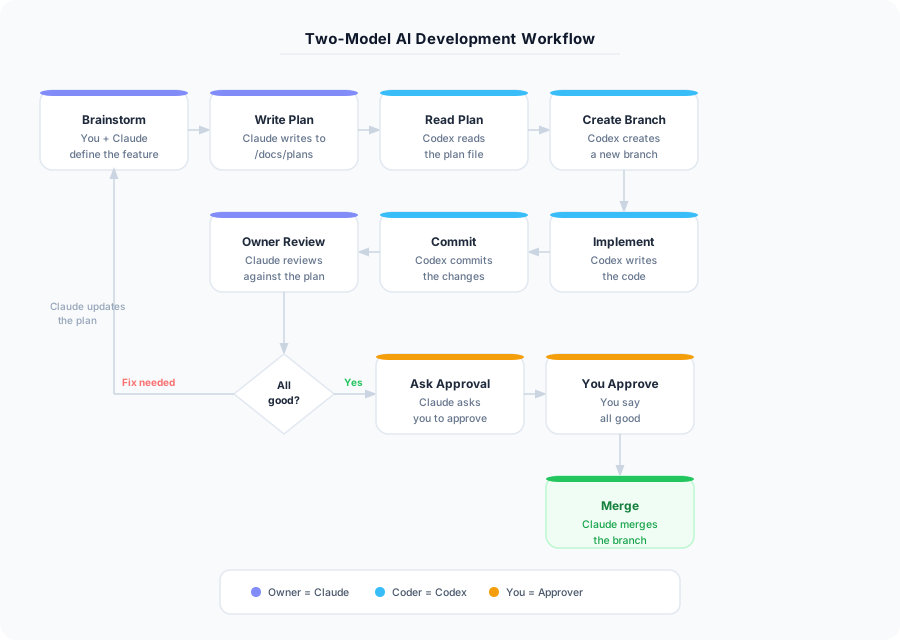
The Review Layer
Codex's job is to write code. That's it. Once it reads the plan, it creates a branch, implements, and commits.
From there it goes back to Claude. Claude reviews the code against the plan and asks me to approve. If I say all good, Claude merges the branch. If something is off, I share what went wrong (sometimes with a screenshot) and Claude updates the plan. Then Codex reads the updated plan and re-implements.
The full loop: Claude plans, Codex creates a branch and builds, Codex commits, Claude reviews, Claude asks for approval, I approve, Claude merges.
It keeps the roles clean. Claude thinks, Codex builds, I stay in control of what ships.
Keep the Tasks Small
This workflow works best for small, well-defined features. Not complex ones.
If a task feels too big, I ask Claude to split the plan into multiple smaller ones. The quality of the output from Codex is directly tied to how clear and specific the plan is. A vague plan gets vague code.
The interesting skill here isn't prompting. It's learning to break down a feature into steps that are small enough to be unambiguous.
A Real Example
I used this to build an interactive map component in React with Three.js for my personal project. The package is open source on GitHub. Claude planned each piece, Codex implemented it, and I never hit a token limit once during the whole build.
Is this perfect? No.
The file system works but it's manual. I'm thinking about replacing it with Trello or GitHub Projects to get proper shared context and a history of decisions, not just flat files.
But that's the next experiment.
The bigger point is you don't have to commit to one model. Different models have different strengths. Mix them, find the split that works, and keep iterating. The tools are good enough now that the interesting question isn't "which one?" It's "how do they work together?"
